the human variable
The Good ShepherdThe human variable is the unpredictable element that makes a convoy both possible and perilous. Ships can be affected by waves, wind, machinery, fuel, and changing displacement, but the people steering, observing, communicating, and interpreting what they see introduce the greatest uncertainty. In close formation, a mistaken order or delayed reaction can convert a minor variation into a collision risk almost at once; at sea, safety depends not on machines alone but on people remaining capable of using them well.
The Convoy as an Interdependent System
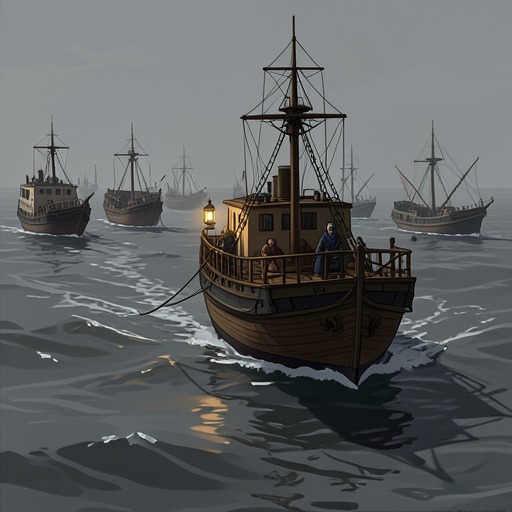
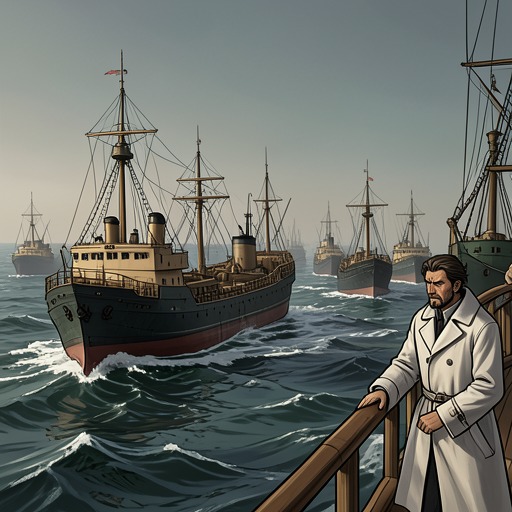
Thirty-seven ships move east together, their routes adjusted at irregular intervals by a few degrees to port or starboard. Their general direction is shared, but their behaviour is not identical. Each responds differently to the rudder, the waves, and the wind; engines, tubes, valves, compasses, fuel, and stores also vary or change. A difference of only a few feet in a minute may become disastrous within twenty minutes when ships are packed into narrow columns, less than half a mile apart in one direction and less than a quarter of a mile in the other.
The convoy’s turns expose how quickly these differences matter. The leading ship in the centre column signals the moment to begin each manoeuvre, following a sequence planned days in advance. Yet a signal does not make the response automatic. A ship may turn incorrectly; its crew may be unsure which turn is due or doubt a neighbour’s competence. A cautious commander who waits to see what others do can lose the moments needed to keep clear. The bows of a ship in the next column may then point toward the side of the one that hesitated. Here the danger is not an abstract failure of coordination: it is the possibility that a delay measured in moments brings ships into fatal proximity.
The formation contains a contradiction. The sea makes the ships look tiny against immense waves, and spreading them out might seem the safer course. But distance would expose them to a different and worse danger. Their tightly managed manoeuvres are therefore necessary even as they leave little margin for error. Human intelligence and accumulated experience make the crossing possible, while the complexity of the system those same capacities have created gives mistakes more ways to propagate.
What People Bring to the System
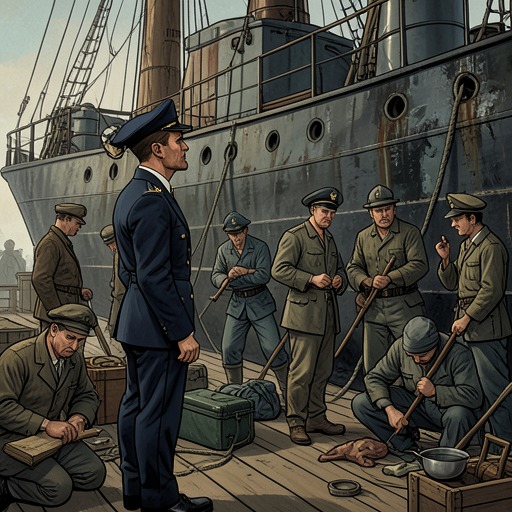
The phrase does not mean simply that some people are competent and others careless. Crews differ in experience, reaction time, caution, and nerve, and their work is distributed across many interlocking duties: keeping propellers turning, ships afloat and in station, equipment working, and the crew fed. The same men may be serving from lofty motives, for money or security, to support children, or while trying to escape personal troubles. Whatever brings them aboard, their actions become part of the ship’s ability to function. In convoy warfare, people and vessels are alike things to be protected, escorted, or destroyed.
Under this pressure, the consequences of human error can arrive faster than those of mechanical variation. A careless order, an order heard incorrectly, a wheel turned the wrong way, or a faulty calculation may produce disaster in twenty seconds. A brief hesitation can be as consequential as a wrong turn: in a crowded formation, waiting for reassurance is itself an action with physical consequences. The narrative thus presents the human variable not as a flaw that can be removed, but as a condition that must be managed through attention, clear orders, experience, and disciplined responses.
Readiness, Training, and the Body
Aboard Keeling, George Krause’s decisions show that readiness has limits. Calling General Quarters would send every man to his battle station, end ordinary routine, and leave routine maintenance for later. Men would lose sleep and have little time to eat; the battle reserve could not be maintained indefinitely. Keeling is already in Condition Two, which keeps most battle stations manned and watertight integrity in force, but strains the crew and the ship. Krause also knows that repeated special demands without an apparent reason can make men slack in their duties. Readiness therefore depends not on demanding maximum effort continuously, but on preserving the crew’s capacity to respond when the decisive moment comes.
That calculation becomes concrete when Krause orders that there will be no routine General Quarters before dawn during the watch. The watch below is to receive its full four hours of rest unless an emergency intervenes. Keeling’s new weapons and instruments have brought additional personnel into already crowded living spaces, and there are not enough trained ratings to staff three Condition Two watches. Krause has divided the company into four sections and established a watch-and-watch routine; his officers generally work four hours on and eight off. His choice to protect rest is an operational measure, not a pause from the work of war: fatigue can undermine the very attention the ship depends upon.
Training presents a related vulnerability. Tom Ellis, a radioman who has served aboard Keeling since the war began, attended the Key West Sound School, where he listened to echoes from a friendly submarine and practised estimating bearing and range. But those hurried exercises were not followed by experience tracking an enemy or by refresher practice. His long months of listening to sonar pings at sea have not meant that he has heard a submarine echo. In a live encounter, he may have to recognize a sound he has never encountered in actual operations and draw the right conclusion quickly. The difference between a depth charge falling ten yards from its target and one falling twenty yards away may determine whether the attack succeeds. Skill is not guaranteed by a qualification or by time on watch; it depends on whether practice has prepared an operator for the task now demanded of him.
Attention Under Physical Strain
The human variable also includes bodily conditions that commanders and crew cannot simply will away. When Krause goes onto the bridge wing in a forty-knot wind, he is insufficiently dressed. He returns chilled through, shuddering and unable to stop his teeth from chattering, and recognizes that he would have reprimanded a young officer for the same lack of preparation. The episode makes the costs of exposure immediate: cold affects the person responsible for maintaining command, even as the weather continues to shape the ship’s work.
Observation aboard Keeling likewise requires sustained effort under poor conditions. Seven lookouts scan separate sectors and repeatedly wipe spray from their binocular lenses. A U-boat may expose only a foot or two of periscope for no more than half a minute; constant, methodical searching offers the chance to detect it. A single glimpse, or the prompt report of torpedo wakes, may affect whether the convoy or Keeling can be saved. The task is monotonous, the signal fleeting, and the consequences of a lapse potentially severe. Its reliability rests on disciplined attention maintained despite the weather and the repetitive work.
Even Krause’s command is subject to fatigue. After roughly thirty hours with only two hours of sound sleep, he nods off on his stool and nearly falls. He is shocked by the lapse and responds by standing, using the discomfort in his legs and feet to keep himself awake; he refuses the thought of changing into slippers because he believes a captain should set an example at his post. The episode does not present self-command as proof that exhaustion has been overcome. Instead, it shows a commander confronting a physical limit that has already intruded on his duty, then trying to compensate for it.
Meaning of the Expression
Across the convoy and Keeling’s operations, the human variable connects large-scale coordination to individual acts: a helm order, a sonar operator’s judgment, a lookout’s uninterrupted scan, a commander’s decision about rest. Neither discipline nor machinery removes the risk. Procedures can organize a turn, distribute work, and preserve battle readiness, but people must interpret signals and carry those procedures out under pressure. The convoy’s safety is produced repeatedly by human performance, while remaining vulnerable to the same performance’s limits. The expression names both sides of that dependence: the people who make the system work and the uncertainty that no system can wholly control.